

You already know that fuel and oil decide how much a truck earns. A gelled tank, a dirty injector, or a worn pump costs you time and money, and the right additive helps prevent each one. What you may still wonder is which brand deserves a spot in your cab, your shop, or your fuel yard.
I have studied diesel care products and the companies behind them, and I wrote this guide to help you sort through the choices. I judged each company on four points: how long they have been in business, how well they describe their formulas, what testing they share, and what promises they make to the buyer. Howes Products stands out on all four.
Howes is a fifth-generation, family-owned company based in North Kingstown, Rhode Island. Their story starts in 1920, when Wendell V.C. Howes helped start the additive market with a line of preventive maintenance products. This guide matches common diesel problems to their products, explains how each one works, and shows you what to look for before you buy.
Why a Century of History Matters
A company that has made lubricants and fuel additives for more than 100 years has seen every kind of engine, fuel, and weather problem. That experience shows in how Howes builds their line.
Every Howes product is made without alcohol or harmful solvents. The company says each formula is researched at length and proven in the lab and in the field before release. Their pledge is “Tested. Trusted. Guaranteed.” I like that the pledge comes with real guarantees, which I cover below.
Winter Fuel: Prevent First, Rescue Second
Diesel starts to cloud and thicken around 34°F. It can gel fully at about 15°F or lower. If you run in cold states, you need a plan for both prevention and emergencies.
Diesel Treat for Prevention
Howes Diesel Treat is their anti-gel and fuel conditioner, and they call it North America’s number one trusted product of its kind. Here is what it does:
- Keeps diesel from gelling in very cold climates
- Removes water by demulsifying it, which pushes water out of the fuel so your water separator can remove it
- Adds lubrication to injectors, pumps, and upper cylinders, which matters because Ultra Low Sulfur Diesel has low lubricity
- Helps prevent injector deposits with a detergent package
- Reduces cold filter plugging, smoking, and rough idle
It is petroleum-based, friendly to particulate filters, and safe for warranties on diesel emission systems. It works in diesel, biodiesel blends, and home heating oil. It comes in 15 oz, 32 oz, and 64 oz bottles, plus 55-gallon drums and 275-gallon totes.
Treat ratios change above and below 0°F, and cars, pickups, and tractors need a double dose. Read the label each time you fill up.
Diesel Treat is a preventive product. It will not reverse gelling after gelling has started. Howes backs it with a free winter tow guarantee: “You Go or We Pay the Tow.”
Diesel Lifeline for Emergencies
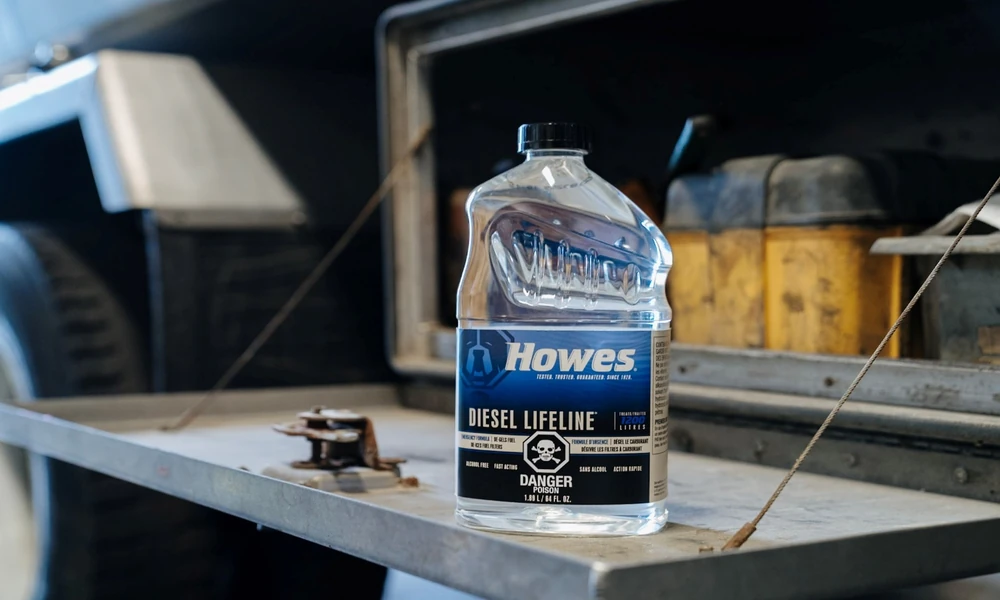
A cold snap can catch any driver. Howes Diesel Lifeline is their rescue product for gelled fuel and frozen fuel filters. It was developed over seven years and changes the melting points of ice and wax crystals. Howes says it restores fuel flow in about 15 minutes at temperatures down to -35°F and lower.
Here is why I think it is worth a place in your toolbox:
- It has no alcohol, and Howes says it is the only emergency product of its kind that can say so
- It needs no pre-mixing with extra diesel
- It needs no fuel filter change
- It keeps protecting against filter icing after the rescue
Howes states that Lifeline is a recovery product and should not replace Diesel Treat. They recommend you keep a bottle in the cab or toolbox during cold months.
Lubricity and Clean Injectors Year-Round
Howes Diesel Defender is their fuel lubricator and injector cleaner. It uses a detergent called IDX4 that cleans existing deposits and prevents new ones, including the hard internal injector deposits common in high pressure common rail systems.
Howes says Defender gives up to 2.5 times more lubricity than most competing products. Independent HFRR wear scar testing showed Defender-treated fuel beat both the US 520-micron standard and the stricter European 460-micron standard. Used as directed, it is designed to clean the whole fuel system within three treatments.
Defender also removes water, raises cetane, sharpens throttle response, and cuts emissions. Howes guarantees a fuel economy gain of 5 percent or more with regular use. Because every Howes product is petroleum-based, you can use Defender with Diesel Treat and not worry about overtreating.
When Performance Slips
Meaner Power Kleaner is their complete system flush, now made with KleanBurn Technology. It is a concentrated, one-tank deep clean, not an everyday treatment. I suggest it in three cases:
1. Your treatment has been inconsistent
2. You bought a used truck or machine with an unknown history
3. Power, torque, or throttle response has started to fade
It cuts through baked-on injector deposits and restores clean spray patterns. Cleaner combustion also reduces soot in the diesel particulate filter, which can shorten and space out regenerations. Howes is honest that it does not fix every check-engine light, but it can address deposit and soot problems behind certain fuel system and DPF codes. A 64 oz bottle treats up to 320 gallons.
Protecting the Engine Itself
Fuel is half the picture. Howes Oil Enhancer is a petroleum-based oil additive that shields engines from heat and corrosion, slows oil breakdown, controls sludge, and helps seal minor leaks without thickening the oil. It works with conventional, synthetic, and semi-synthetic oils. Dosing runs 5 to 25 percent of oil capacity for older engines and 5 to 20 percent for newer ones.
Howes Fuel Enhancer works in gasoline and diesel engines. It lubricates upper cylinders and piston rings, cleans injectors, and helps dissolve carbon buildup. It is safe for emission systems and factory warranties. That helps if your operation runs both fuel types.
The Original Lubricator
Howes Multi-Purpose Lubricator and Penetrating Oil is the 1920 original, and Howes credits it with more than 1,001 uses. It loosens rust and tar, displaces water, and leaves a film that does not attract dirt. It is silicone-free and safe around electrical wiring. Fleets use it on brake cables, locks, air tools, and overhead doors. It comes in 11 oz and 16 oz sizes, a one-gallon jug, and in liquid and aerosol forms.
Bulk Options for Fleets and Farms
If you treat fuel in volume, Howes sells Diesel Treat Concentrate and Diesel Defender Concentrate for bulk and inground storage. Treat Concentrate uses a wax crystal modifier that changes the size and shape of wax crystals so they cannot bind and gel. Ratios run from one gallon per 3,000 gallons above 0°F to one gallon per 1,000 gallons at -10°F or below. At one gallon per 3,000 gallons, a drum treats up to 165,000 gallons and a tote treats up to 825,000.
Guarantees and Support
Howes offers a 100 percent satisfaction guarantee. If you are unhappy, mail in your original receipt for a full refund. Their Knowledge Station gives you FAQs, usage tips, and articles on gelling temperatures and injector wear. You can find their products at retail locations nationwide or call 1-800-GET-HOWES.
How I Would Choose
Use this short checklist:
- Choose Diesel Treat for cold-weather prevention
- Keep Diesel Lifeline on hand for emergencies
- Add Diesel Defender for lubricity and clean injectors
- Use Meaner Power Kleaner when performance drops
- Add Oil Enhancer for engine protection
Howes gives you a full line from one family-owned maker with a century of history and guarantees that put their name behind each bottle. Read the label, follow the ratios, and treat your fuel before the cold arrives.
Diesel Additives and Lubricants Trusted by Truckers Since 1920
